Dental Implants vs. Bridges: How to Compare Tooth Replacement Options
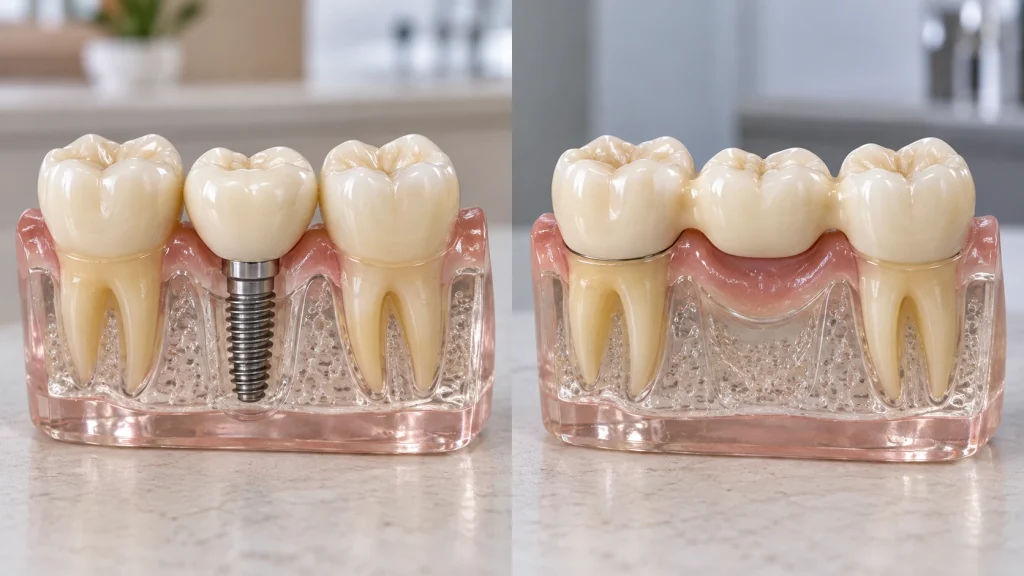
Dental implants and bridges replace missing teeth, but they rely on different kinds of support. An implant-supported crown is anchored in the jawbone; a traditional bridge is supported by neighbouring teeth. Choosing between them depends on those teeth, your gums and bone, your health, and the care each option requires. Neither is right for everyone.
For patients comparing options at Roseborough Dental in Mississauga, at Eglinton and Creditview, the useful question is: what would each choice involve for my mouth, now and later?
How dental implants and bridges differ
A single implant replaces a missing tooth root and supports a replacement crown. A traditional bridge spans the gap, usually with a replacement tooth joined to crowns on the teeth beside it. Those supporting teeth need reshaping.
If you’re exploring dental implants in Mississauga, use the service information as background, then ask how an implant would compare with a bridge in your particular situation.
Here are the main differences to discuss:
- Support: an implant uses the jawbone; a traditional bridge relies on neighbouring teeth.
- Preparation: implant treatment involves surgery; a traditional bridge involves preparing its supporting teeth for crowns.
- Planning: implants require assessment of bone and healing; bridges require assessment of the supporting teeth and the forces they will carry.
- Cleaning: both need daily care, including cleaning around the implant or beneath the bridge.
“Bridge” doesn’t always mean a tooth-supported restoration. Some bridges attach to implants, and other designs use different attachments. Ask which design your dentist is comparing before weighing the advantages.
Start with the teeth beside the gap
The condition of neighbouring teeth can change the balance between the options. If those teeth have little previous dental work, ask what would be removed to support a traditional bridge. An implant-supported crown can avoid preparing adjacent teeth for bridge crowns.
If the neighbouring teeth already need significant restoration, the discussion may be different. Ask whether crowns are needed independently of replacing the missing tooth, and whether those teeth are strong enough to support a bridge. Having a large filling does not automatically make a tooth a dependable support.
Roseborough Dental’s restorative dentistry information provides context for crowns and bridges. During an assessment, ask the dentist to show you the proposed supporting teeth and explain their condition. You should understand what treatment each tooth needs and why.
Consider bone, gums and your health history
Implant planning includes assessing the available bone and gum health. A bridge also needs a healthy foundation, including dependable supporting teeth. An attractive replacement tooth cannot compensate for an untreated problem underneath it.
The Canadian Dental Association’s dental implant guidance describes the role of an examination and X-rays in assessing an implant site. Where bone is insufficient, ask whether additional treatment would be considered and how that would affect the options.
Bring an updated medication list and explain relevant health conditions, previous dental treatment and tobacco use. Let the dentist assess their significance rather than assuming that a diagnosis automatically rules an option in or out.
You can also ask what needs attention before tooth replacement begins. Separating preliminary care from the replacement itself makes the recommendation easier to understand and compare.
Weigh surgery, healing and everyday logistics
Implant treatment involves surgery and a period of healing. A conventional tooth-supported bridge does not require implant placement, but still involves dental treatment and preparation of supporting teeth. Neither choice should be described as effortless.
Ask about the stages proposed for you, what could change the plan and how progress will be assessed. Avoid treating an advertised completion time as a personal forecast. Extra procedures, existing dental problems and healing can affect the sequence.
Practical concerns deserve a place in the conversation. If the gap is visible, ask what temporary replacement might be possible. If you care for someone, travel frequently or have limited time away from work, explain that early.
Also ask who would provide each stage of care and whom you would contact with concerns. A clear explanation of responsibilities matters more than a simplified promise about speed.
Compare cleaning and future maintenance
Choose with your daily routine in mind. Both restorations need cleaning and professional monitoring. Ask for a demonstration of the care your proposed design would require, especially if reaching the area is already difficult.
The Canadian Dental Association’s bridge guidance explains cleaning under and around the replacement tooth using a floss threader. Implant care also includes cleaning around the restoration and monitoring the surrounding tissues. Your dental team can explain the tools appropriate for the design.
Think beyond whether the replacement tooth can develop a cavity. Supporting natural teeth and the tissues around a restoration still need care. Ask how the dentist will monitor those areas and what changes should prompt a call.
Neither option comes with a guaranteed lifespan. Ask what might need adjustment, repair or replacement, and whether work on one component could affect others. A treatment estimate is more useful when you understand the likely maintenance responsibilities as well as the initial work.
Questions to ask when comparing tooth replacement options
A consultation should leave you understanding the reason behind a recommendation. You don’t need to know all the terminology before asking for a clearer explanation.
Bring these questions, or choose the ones that matter most to you:
- What findings make an implant or bridge worth considering for my mouth?
- Which bridge design are we discussing, and what would support it?
- Would the neighbouring teeth need treatment even if I chose an implant?
- Does either option require preliminary care, and why?
- What are the important risks and limitations in my case?
- How would I clean the finished restoration at home?
- What could change the treatment sequence or written estimate?
- What happens if a supporting tooth, implant or replacement crown develops a problem?
- Are there other reasonable options, including a removable replacement, that I should understand?
Ask for the proposed treatment and estimate in writing. The comparison should identify what is included, any additional procedures being considered, and follow-up responsibilities. Confirm benefits directly rather than assuming a dental plan will cover either option.
If you still feel uncertain, explain the unresolved concern. You may need a demonstration of cleaning, a clearer explanation of the supporting teeth, or more information about surgery. Those are useful questions, not obstacles to making a decision.
Frequently Asked Questions About How Dental Implants Compare To Bridges
Are dental implants always better than bridges?
No. Dental implants and bridges have different requirements, and the recommendation depends on the findings in your mouth. Ask which specific advantages and disadvantages matter in your case, rather than relying on a general ranking.
Can a bridge be supported by implants?
Yes, an implant-supported bridge uses implants rather than natural teeth for support. That means “implants versus bridges” is not always an either-or choice. Ask whether the proposed restoration is a single implant crown, a tooth-supported bridge or an implant-supported bridge.
Will I be without a tooth during treatment?
A temporary replacement may be possible, but the arrangement depends on the treatment plan and the area being treated. Ask how appearance, eating and cleaning would be managed between stages. Don’t assume the temporary option will function exactly like the final restoration.
What if I’m anxious about implant surgery?
Tell the dentist about your concerns before choosing a treatment. Ask what the proposed procedure involves and what comfort measures may be appropriate for you. Anxiety deserves discussion alongside the clinical tradeoffs, without assuming a particular approach will be available or suitable.
Can I choose a bridge now and get an implant later?
A later implant would require a fresh assessment; it is not an automatic next step. Ask how preparing supporting teeth, changes in the gap and future treatment needs could affect that possibility. Make the current decision with those uncertainties explained.
Talk to Roseborough Dental about your tooth replacement options
You don’t have to arrive with a preferred treatment. Bring your questions, medication list and the practical concerns that matter to you, such as cleaning access, anxiety or managing appointments.
Roseborough Dental is a dental practice at Eglinton and Creditview in Mississauga. To discuss an assessment of a missing tooth, contact Roseborough Dental. Ask for an explanation of the reasonable options, the reasons behind any recommendation and the tradeoffs you would be accepting.
This article provides general information. An individual dental assessment is needed to discuss suitability, risks and a treatment plan.